Range Repair · Denver
Viking Burners Burning Yellow in Denver? Start With the Orifices
Lazy yellow flames and sooted pans on a Viking range at Denver's elevation are usually an air-to-gas mixture problem, not a failing burner. How to read the flame, check whether the high-altitude orifices were ever fitted, and rule out the other three causes.
Written by Natalia Vukovic
Service technician — water systems and leaks · 17 years in the trade
Finds where the water goes before deciding what is wrong. A seal that shrank at the corner and a fitting that weeps look the same on the floor and cost nothing alike.
A Viking burner is supposed to burn a tight, mostly blue cone with a small pale core. When the outer flame goes soft and yellow, lifts away from the port and starts leaving grey soot on the underside of a pan, almost nobody calls about the flame. They call because the pans are filthy and the kitchen smells faintly of a campfire.
At Denver’s elevation that symptom has a favourite cause, and it is not a failing burner. It is the mixture.
What a healthy Viking burner flame looks like
Work in a dim kitchen and look at the flame from the side, at eye level with the port ring.
- Correct: crisp blue cones, roughly even height around the ring, a faint pale-blue inner core, and near-silence except for a low hiss.
- Too little air: tall lazy flames, orange or yellow at the tips, tips that wander and separate from the port. Soot follows within a week or two.
- Too much air: flames that look starved, sit hard against the port, and blow themselves out when you turn the knob down to simmer.
Yellow is the one to act on, because it is the one that dirties the appliance and wastes the gas you are paying for. It also tends to get worse: soot builds up inside the burner venturi, restricts the air path further, and pushes the mixture even richer.
Why a mile of elevation changes the mixture
A gas burner does not measure anything. Gas leaves the orifice at a fixed rate for a given pressure, and the momentum of that jet drags room air in through the air shutter behind it. The ratio between the two is what determines the colour of the flame.
Denver sits at about 5,280 feet, where the air is roughly 17 percent less dense than at sea level. The same orifice, at the same manifold pressure, is now pulling in air that carries meaningfully less oxygen per cubic foot. The mixture tilts rich. The flame goes yellow.
That is exactly why manufacturers publish high-altitude orifice sizes and supply them as a kit — a smaller bore delivers less gas so the thinner air can keep up. The work is meant to happen at installation, and on a lot of ranges in this city it simply never did. A range that burned perfectly in a warehouse in Mississippi gets uncrated in a Denver kitchen, fired up once to check that it lights, and signed off.
Two clues that this is your problem rather than something else:
- It was never right. The flames have looked lazy since the day the range was installed, or since it was moved here.
- Every burner is doing it. A part that fails takes one burner with it. A mixture that is wrong for the elevation is wrong across the whole cooktop.
Checking whether the orifices were ever changed
You can do most of this yourself in fifteen minutes with the gas off.
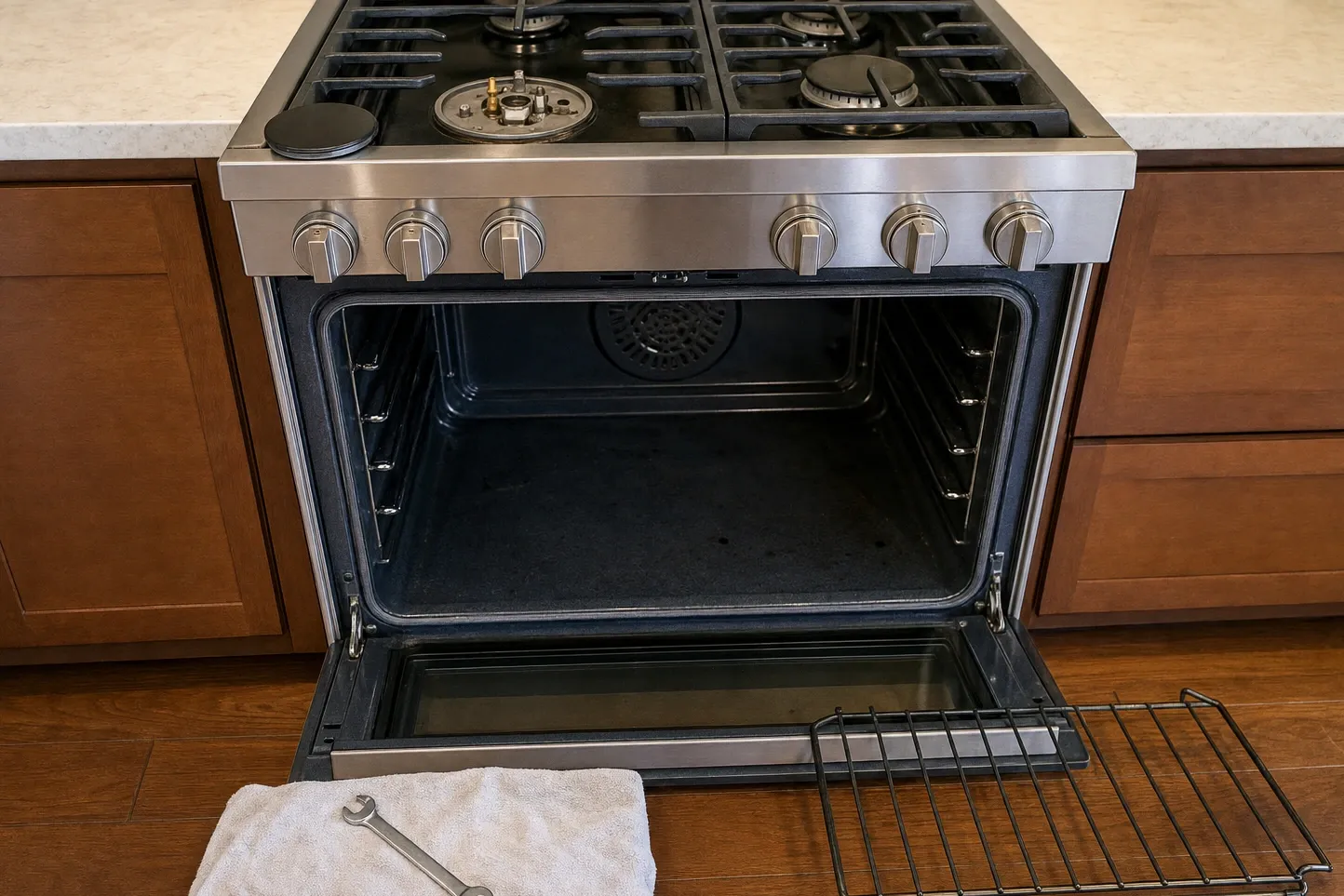
Lift the grates and the burner caps off. Under each cap sits the burner head, and under that, at the bottom of the well, is a brass fitting with a small bore through the middle — the orifice, sometimes called the spud. Many Viking orifices carry a stamped number on the flat, and that number is the bore size. It should match the high-altitude column of the table in the installation manual for your model, not the sea-level column.
If the numbers match the sea-level column, that is your answer and the fix is a set of orifices.
While you have it apart, look at two other things:
- The air shutter, a sleeve or plate at the back of the burner venturi. Grease and a decade of spatter close them up. A shutter that has been painted shut by cooking residue starves the burner of air just as effectively as the wrong orifice.
- The ports, the small drilled holes around the burner head. Cleared with a stiff brush and a pin, not with a drill bit — a widened port never goes back.
The three other causes of a yellow flame
If the orifices are correct for altitude and the shutters move freely, look at these before assuming a part has failed.
Manifold pressure. Set with a manometer at the pressure tap, not by feel. Too high and the jet overpowers the available air. This is the one item on this list that is genuinely not a homeowner job.
Something in the airway. Cooktops that sit above an oven share a cavity with it. Spilled sugar, a foil scrap, a mouse nest in a house that sat empty — all of them block the path the burner draws air through.
A dirty burner head. Carbon inside the venturi makes the passage effectively narrower and the mixture richer. It looks like a mixture fault because it is one; the cause is just crust rather than configuration.
When it is worth calling someone out
Cleaning ports and freeing an air shutter is reasonable weekend work. Changing orifices and setting manifold pressure is not, for a plain reason: both involve opening a live gas connection and then verifying that nothing leaks, and the verification is the part people skip.
Worth a call if:
- the orifices are wrong for the elevation and you would rather not open the gas line yourself
- one burner is yellow and the others are fine, which points at that burner’s head, its shutter or its own orifice
- the flames stayed yellow after a thorough clean
- you can smell gas at any point, in which case shut the supply valve, open a window and call before doing anything else
We set orifices and shutters to the manufacturer’s high-altitude figures, check manifold pressure with a gauge, and leave every burner burning blue at full and holding a stable low flame at simmer. The $89 service call covers the visit and the full diagnosis, and it comes off the repair once you approve it.
Follow-ups we get asked
Is a yellow flame on a gas range dangerous?
A yellow-tipped flame is burning less efficiently and producing more carbon monoxide than a blue one, and it deposits soot on cookware and on the burner itself. It is not an emergency the way a gas smell is, but it should not be left alone for months. If you can smell unburnt gas, shut the supply off at the valve and call.
Can I drill the existing orifices instead of replacing them?
No. Orifice bores are sized to a table and drilling them by hand gives an uneven, oversized hole that cannot be undone. The correct orifices are inexpensive parts that arrive as a set for your model.
Will converting to propane fix a yellow flame?
Only if the range is being fed propane and is still set up for natural gas, which is a different fault. Converting a correctly configured natural gas range to propane will not improve mixture and will make things considerably worse if the supply is unchanged.